













Recently viewed (0)
No viewed cars.Saved (0)
Vehicle Locator
Current Models
Current Models



Paintless Dent Removal for Luxury Cars near Newtown, CT
Door dings are democratic. They happen to a $30,000 commuter and a $300,000 GT car at the same parking-lot rate, and they always seem to land on the panel you look at every morning. The difference is what you do about it. If you have been searching for paintless dent removal for luxury cars near Newtown, CT, this page covers what PDR is, what it can and cannot fix, and why the technician you hand the keys to matters more than the marketing on the website.
PDR done well leaves no evidence the dent was ever there: no paint mismatch, no body filler, no Carfax body-shop entry. PDR done poorly stretches the metal, breaks the paint, and turns a minor cosmetic issue into a panel replacement. The gap between those two outcomes is almost entirely about who is holding the tools.
What Paintless Dent Removal Actually Is
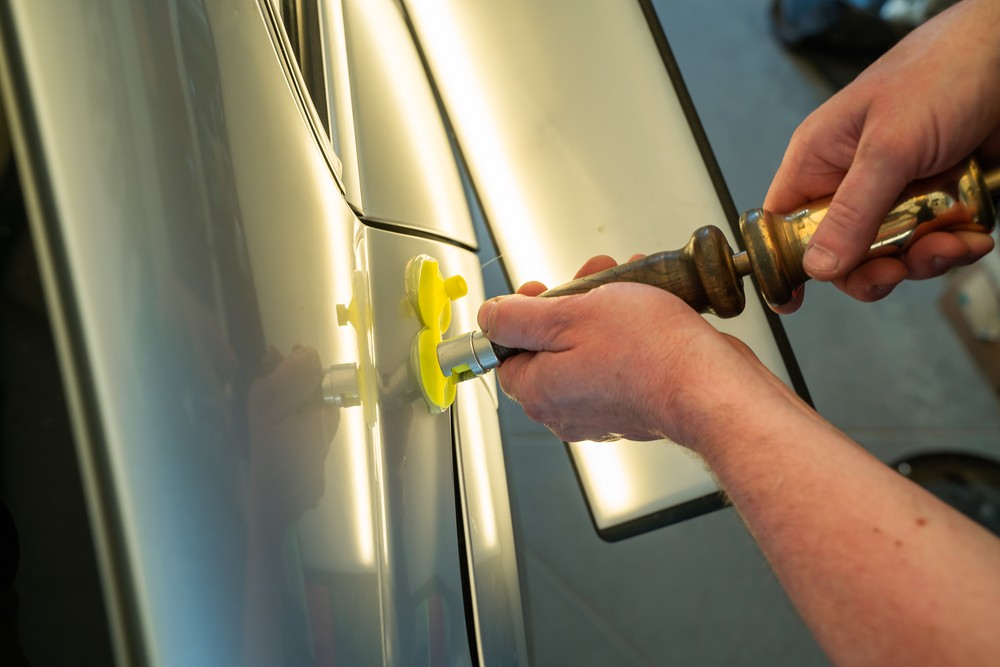
Paintless dent removal (also called PDR or paintless dent repair) is a specialized technique for working dents out of a panel from behind, without disturbing the original paint. A trained technician uses purpose-built rods, picks, and tabs to massage the metal back to its factory contour, often working through small access points behind the panel, inside a door cavity, through a trim opening, or via a manufacturer-designed access port.
The basic principle is straightforward. Modern automotive sheet metal has memory: when struck, it deforms in predictable patterns and wants to return to its original shape. PDR works with that memory rather than against it. Done correctly, the metal returns to factory contour, and the original paint is undisturbed. Done incorrectly, the metal is stretched beyond its elastic limit, the paint cracks, and the panel needs traditional bodywork or replacement.
When PDR Is the Right Call
PDR is the right approach when three conditions hold: the dent is shallow enough to work with, the paint is unbroken, and the panel allows access from behind. A few common scenarios where PDR is typically the right call:
• Door dings from parking lots. The single most common PDR job. A shopping cart, an adjacent car door, or a careless cyclist puts a dimple in your door. PDR usually returns the panel to the factory in a single visit.
• Hail damage. Hailstorms cause large numbers of small dents across the hood, roof, trunk, and upper body panels. PDR is the standard repair method, often covered by comprehensive insurance, and far less invasive than repainting the affected panels.
• Minor crease damage. A creased dent (longer than it is deep) where the paint has held can often be PDR-repaired, though it usually takes more time than a round dent of similar size.
• Small fender, bumper, and quarter-panel impacts. Many minor low-speed contact dents qualify for PDR if access is available and the paint is intact.
• Body-line dents (with caveats). Dents on or near a body line (the sharp character lines that run along the side of most modern cars) are technically demanding but achievable for skilled technicians. This is where experience separates a competent shop from an excellent one.
When PDR Is Not the Right Call
PDR is not a universal solution, and an honest shop tells you when it is not. We will not attempt PDR on damage that requires traditional bodywork; the cost of a failed PDR attempt is almost always higher than starting with the right repair. A dent typically falls outside the PDR scope when:
• The paint is broken. If the impact has cracked, chipped, or scratched the paint through to bare metal, PDR alone cannot resolve it. The panel needs traditional repair or paint touch-up to address the paint, even if the metal can be reshaped.
• The metal is stretched. Severe impacts can stretch the metal beyond its elastic limit. Once stretched, the panel will not return to its factory contour, and forcing it can create a wave or oil-canning effect. Traditional bodywork is required.
• Access is blocked or impossible. Some panels have no realistic access point from behind, certain quarter panels, certain modern bonded constructions, and panels covered by interior structure. In these cases, the panel must be partially disassembled or replaced.
• The damage is on a structural panel. Frame rails, structural pillars, and crumple zones are not candidates for PDR under any circumstance. Structural damage requires inspection by a qualified body shop and likely replacement.
• Aluminum panels with significant damage. Aluminum (used on many modern luxury vehicles such as the Audi A8, R8, Range Rover, Tesla Model S, Jaguar XJ, and certain BMW and Mercedes panels) is less forgiving than steel and requires technicians with specific aluminum experience. Minor aluminum dents are PDR candidates; significant ones often require a body shop with aluminum certification.
PDR vs Traditional Body Shop Repair
When a dent qualifies for PDR, the comparison with traditional body shop repair is meaningful. Where it does not, traditional repair is the right answer. Both approaches have a role.
| Aspect | Paintless Dent Removal (PDR) | Traditional Body Shop Repair |
| Original paint | Preserved entirely. No repainting required. | The affected panel is repainted. Color-matched to surrounding panels, but technically no longer factory paint. |
| Carfax/vehicle history | No body-shop entry generated. Original paint factory original. | Body-shop entry typically appears in Carfax / AutoCheck records, which can affect resale. |
| Turnaround | Most jobs same-day or next-day. Minor dings sometimes complete within an hour. | Usually 3–7 business days for single-panel work, longer for multi-panel. |
| Cost | Generally lower than traditional repair for the same damage. | Higher paint, materials, and labor costs add up. |
| Resale value | No measurable impact. The panel is original. | Modest impact possible. Future buyers and dealers may discount for documented bodywork, especially on collector-grade vehicles. |
| When it works | Shallow dents, unbroken paint, accessible panel. | Broken paint, stretched metal, structural damage, or no rear access. |
Why Luxury Cars Need a Specialist
PDR on a daily-driver Honda is a different skill set from PDR on a Porsche, a Range Rover, or a low-mile Aston Martin. Luxury and exotic vehicles introduce specific considerations that a general PDR shop may not handle correctly:
• Aluminum and mixed-material panels. Many modern luxury vehicles use aluminum body panels, sometimes mixed with steel and high-strength composites in the same vehicle. Each material responds differently to PDR tools and pressure. Working with aluminum like steel is one of the fastest ways to ruin a panel.
• Specialty paint finishes. Pearlescent paints, multi-layer metallics, matte and satin finishes, and ceramic-coated paint each react differently to the heat and tool pressure that PDR can introduce. A technician who has only worked on standard finishes can damage a specialty finish without realizing it until the work is done.
• Tighter tolerances. Luxury bodywork is built to tighter tolerances than mainstream vehicles. The same dent that would be invisible after PDR on an Accord might leave a slight wave on a 911 panel if the technician is not experienced with the material. The acceptable margin for error is smaller.
• Access through complex interiors. Modern luxury door cards, headliners, and trim pieces are more delicate and more interconnected than their mainstream equivalents. Disassembling and reassembling without breaking clips, scratching trim, or disturbing wiring requires specific experience.
• Body-line precision. Luxury vehicles often have more pronounced and more numerous body lines than mainstream cars. Working a dent that touches a body line requires specific technique, more time, and tools designed for line work specifically.
Why Our Body Shop Stands Out for Luxury PDR
Several factors separate competent PDR from excellent PDR on luxury vehicles. We have built our shop around these specifically.
Experienced PDR technicians
Our PDR technicians have collective experience working on the brands and panel types that make up the bulk of Newtown-area luxury inventory: Porsche, BMW, Mercedes-Benz, Audi, Tesla, Range Rover, Lexus, Jaguar, Aston Martin, Maserati, and Ferrari.
Aluminum and mixed-material capability
Our shop is set up to handle aluminum body panels alongside steel, with dedicated tools and a workflow that prevents cross-contamination between the two materials. Aluminum cross-contamination is a known issue at general PDR shops and can compromise long-term panel integrity.
Specialty finish handling
We assess specialty finishes (matte, satin, pearlescent, ceramic-coated) before starting work and adjust technique accordingly. On finishes where any heat or pressure risk exists, we walk through the trade-offs with you before beginning.
Honest scope assessment
We tell you when PDR is the right call and when it is not. If a dent falls outside PDR scope, we say so up front and either route the job to traditional bodywork in-house or refer to a partner shop for work outside our scope. We would rather lose a job we cannot do well than attempt one and disappoint the owner.
Clean, climate-controlled work environment
PDR work benefits from controlled lighting, stable temperature, and a dust-free environment. Working a dent under the wrong light can hide a wave that becomes visible in sunlight; working in cold metal is harder than working in warmed metal. Our shop is purpose-built for this work.
Documentation
Before-and-after photography on every job, written assessment notes, and digital records sent to the owner. This documentation is useful at trade-in or sale, even though PDR does not generate a Carfax body-shop entry.
What to Expect from the Process
A typical PDR appointment runs through a predictable sequence. Most jobs are completed in a single visit; complex or multi-panel jobs may require a second day.
• Initial assessment. A technician inspects the dent under controlled lighting, evaluates whether it qualifies for PDR, and provides a written estimate. This is free and takes 15–30 minutes for most cases.
• Approval and scheduling. If you approve, we will schedule the work. Single-panel jobs often complete the same day; multi-panel or hail damage may require an appointment 1–2 weeks out, depending on workload.
• Preparation. Interior trim, door panels, or other components are removed only as needed to access the back of the affected panel.
• Repair. The technician works the dent out using PDR rods, glue-pull tabs, or a combination, depending on access and dent geometry. Progress is checked under controlled lighting as work proceeds.
• Final inspection. The repaired panel is inspected from multiple angles under different lighting conditions to confirm that the work is complete and uniform with the surrounding panels.
• Delivery. Trim and components are reinstalled. We walk the result with you in natural light before you take the car. If anything is not right, we make it right before you leave.
Convenient for Drivers Across Western Connecticut
Alfa Romeo of Westport is a drive from Newtown via Route 25 and the Merritt Parkway, with additional access from I-95 and Post Road for clients along the shoreline. We regularly work with luxury vehicle owners from Sandy Hook, Bethel, Brookfield, Danbury, Southbury, Monroe, Easton, Trumbull, Ridgefield, Redding, and the broader inland Fairfield County area, alongside clients from Norwalk, Wilton, Weston, Fairfield, and Darien, closer to our Westport location. Owners from Westchester County, NY, visit us by appointment, and we coordinate appointments with vehicle delivery for clients whose schedules do not allow a personal drop-off.
If you cannot make a weekday visit, we offer Saturday assessments and pickup-and-delivery service within a defined radius. For collector-grade vehicles or low-mileage examples, we recommend a private appointment so the assessment, documentation, and walk-around can happen without time pressure.
The Bottom Line
Paintless dent removal is the right answer for the majority of cosmetic dents on a luxury car: faster, less invasive, and free of the resale and Carfax concerns that come with traditional repaint work. The hard part is finding a technician who handles luxury vehicles, aluminum panels, and specialty finishes with the precision they require. That is the work we have built our shop around.
Schedule a free PDR assessment at Alfa Romeo of Westport by calling 866-692-1277 or completing our online appointment request. We will walk through the dent, the options, and the realistic outcome before any work begins.
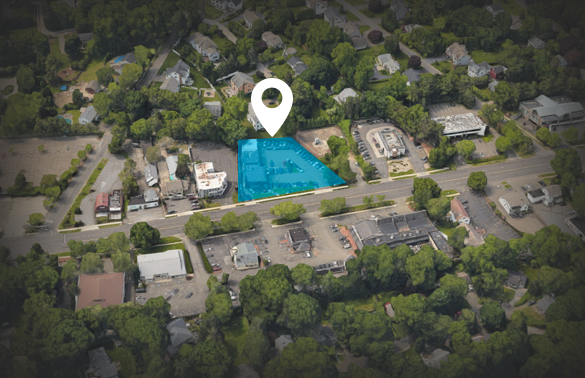
LOCATION
Alfa Romeo of Westport
1026 Post Road East
Westport, CT 06880
HOURS
Monday - Friday:
9:00AM - 6:00PM
Saturday:
9:00AM - 4:00PM
Sunday:
Closed


* Images, prices, and options shown, including vehicle color, trim, options, pricing and other specifications are subject to availability, incentive offerings, current pricing and credit worthiness.The advertised price does not include sales tax, vehicle registration fees, other fees required by law, finance charges and any documentation charges.
We make every effort to ensure the accuracy of the information on this site, however errors do occur. Please verify all information with a sales associate by calling or e-mailing us.
If a person writes a check without sufficient funds in an associated account to cover it, the check will bounce, or be returned for insufficient funds. Each state has laws regulating how merchants may respond to bounced checks. In Connecticut, the merchant may file a civil suit and press criminal charges if the check writer does not reimburse him for a bounced check after the merchant has sent several notices regarding the matter.
Posted Notice Requirement
Merchants and other business owners who accept checks must post a notice where customers are likely to see it warning them of the potential consequences of writing bad checks. The notice must include the civil penalties that bad check writers may face, the appropriate Connecticut statute number and an advisory that the check writer may also face criminal penalties
Civil and Criminal Penalties
As of 2010, civil courts may require the check writer to reimburse the merchant for the value of the check plus pay up to $750 if he has no back account or $400 if the check is returned for insufficient funds. If the merchant chooses to press criminal charges, the bad check writer may face a fine of up to $1,000 and up to one year in jail. Writing a bad check is a felony charge if the check was for more than $1,000 and a misdemeanor if written for a lesser amount.
Required Written Notices
If a check bounces, the merchant must send the check writer a letter by certified mail at the check writer's last known address or place of business. Usually this letter is sent to the address on the writer's check. The letter must inform the writer that the check was returned ask him to reimburse the merchant for the amount of the check and inform him of the potential criminal or civil penalties if he fails to do so. If the check writers does not respond to the letter within 15 days of receipt, the merchant must send a second letter. This letter must inform the check writer that he has 30 days to reimburse the merchant before the merchant takes legal action against him. Both letters must be written in both English and Spanish.